
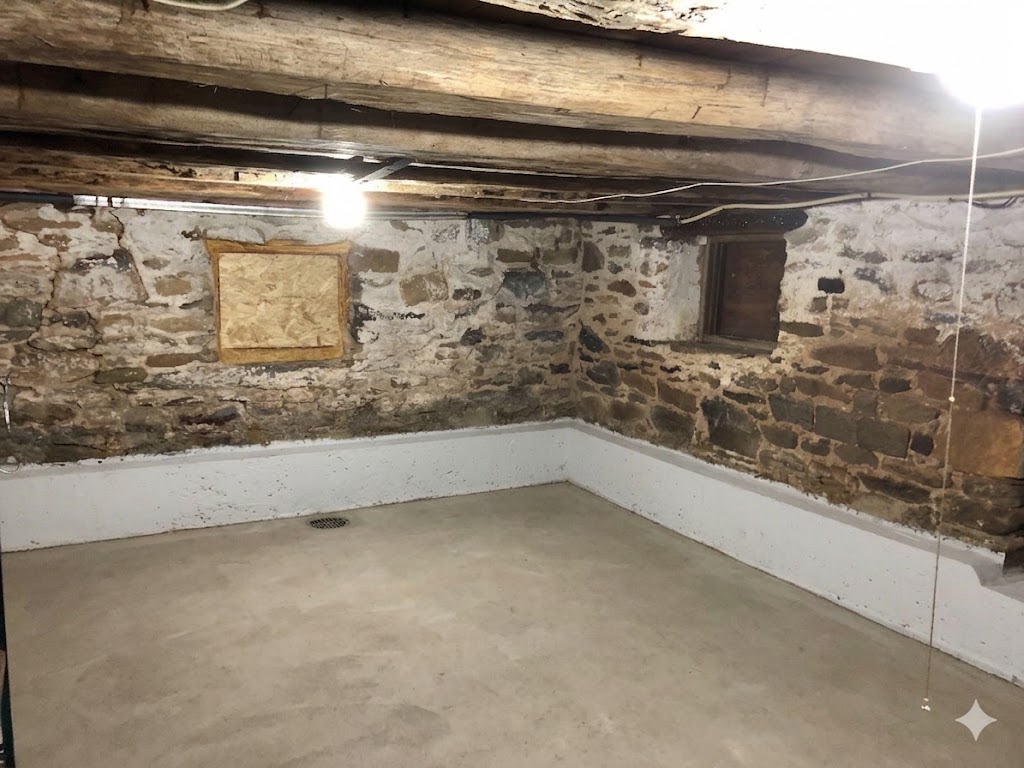
If you’re under contract on a pre-1925 home in Loudoun, Fauquier, Rappahannock, or elsewhere in the region, the foundation under that house has been doing its job for longer than your grandparents have been alive. It is also probably the system you understand the least, and the one your home inspector glances at the fastest.
I’ve spent twenty years working on and inspecting masonry across Northern Virginia. Old foundations are not problems to “fix” — they’re systems to understand. Here is what I actually look for when I’m down in a 1910 Leesburg crawlspace with a flashlight and a sharp pick, and what every buyer of a historic home should know before closing.
What “100 years old” actually means in this part of Virginia
Loudoun’s housing stock from roughly 1880 to 1930 was built before concrete was standard residential foundation material. That means most pre-1925 foundations in the area are one of three types:
- Rubble or fieldstone — irregular stones laid up in lime mortar. Common in the oldest homes (pre-1900) and in rural farmhouses across Loudoun, Fauquier and Rappahannock.
- Cut stone — squared and coursed stone, usually limestone or sandstone, found in the more substantial Leesburg homes of the 1890s through 1910s.
- Solid brick — common in 1900–1930 era homes, particularly closer to downtown Main Street.
You’ll occasionally see early concrete from the 1910s and 1920s, but it’s rare. By the time your house was built with a poured concrete foundation, it probably isn’t 100 years old yet.
Each material ages differently. Each fails differently. And each one needs to be read by someone who actually knows the difference between aging and failing.
The five things I look for first
1. Movement that has stopped vs. movement that’s still happening
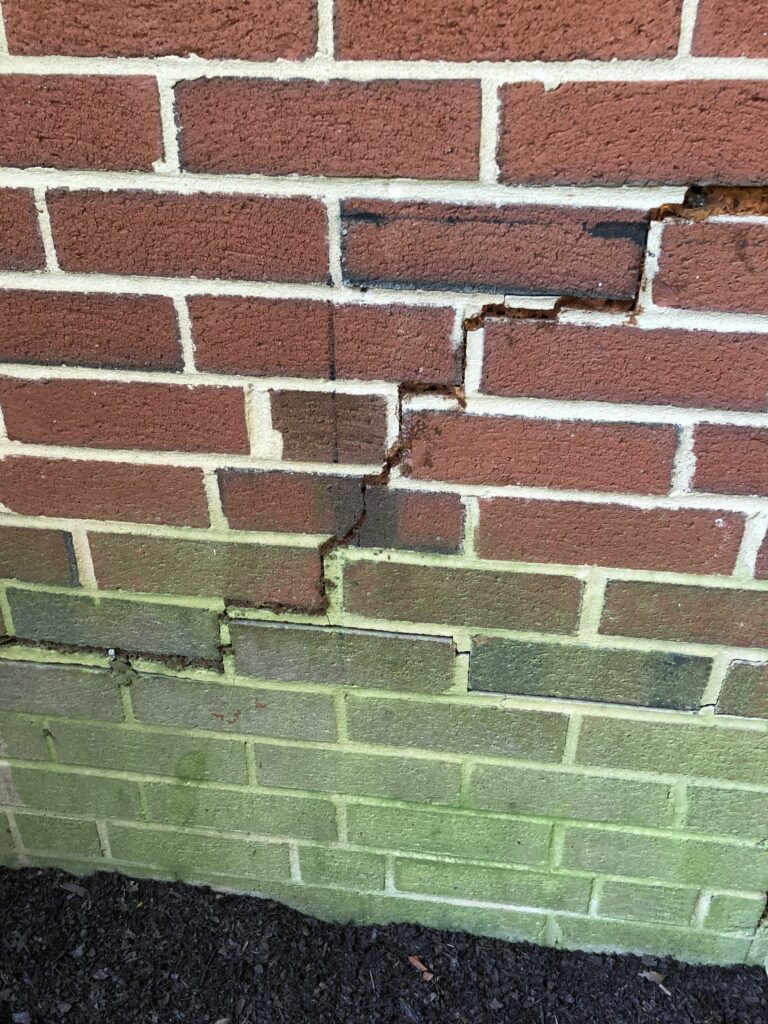
Every old foundation has moved. Frost heave, settlement, soil moisture cycles — over a century, every wall has shifted somewhere. The question isn’t whether it’s moved. The question is whether it’s still moving today.
I look for:
- Old cracks that have been pointed and have stayed closed. That’s a wall that moved, was repaired, and has been stable since. Almost always fine.
- Cracks with fresh edges — sharp clean breaks in the mortar joints, freshly exposed stone surface, or new debris on the floor below. That’s active movement.
- Step cracks running diagonally through mortar joints. These speak to differential settlement. Sometimes resolved decades ago, sometimes ongoing.
- A door upstairs that won’t latch, sitting directly above a corner with movement. The upstairs is telling you what the foundation is doing.
The diagnostic tool I use most often here is a five-dollar pencil. I trace any suspect crack lightly, photograph it, and check it on the next visit. If the new line stays inside the pencil mark, the wall is stable. If it’s drifted outside, it’s active.
2. Lime mortar that looks like it’s failing — but isn’t
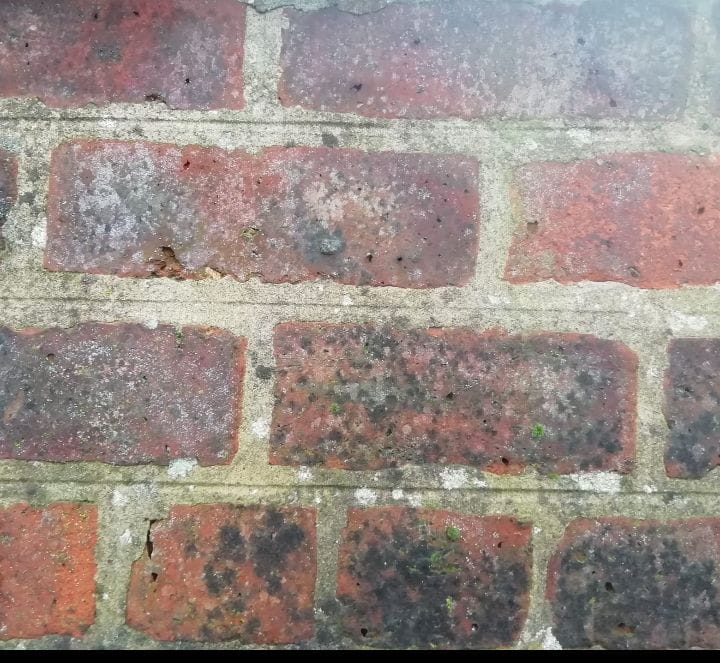
The single most common mistake I see in inspection reports on historic Loudoun homes is calling lime mortar “deteriorated” or “failed.” It is not. Lime mortar is supposed to look softer and more porous than modern Portland cement mortar. That’s not a defect — it’s the design.
Here’s why: lime mortar is the sacrificial layer that protects the stones. It’s deliberately softer than the stone, so that as the building moves over centuries, the mortar fails in small cracks instead of the stones cracking. When you repoint lime-mortar masonry with modern Portland cement, you actually destroy the stones over the next 30 years because the cement is now harder than the rock — and any movement now breaks the rock instead of the joint.
So when I see a 1905 stone foundation in Loudoun with mortar that’s slightly recessed and a little crumbly at the surface, that’s normal. The repair, if any is needed, is to repoint with a lime-based mortar (ASTM Type O or softer), not Portland.
What does need attention: large voids deeper than half an inch, missing mortar exposing the back faces of stones, or any place water is actively channeling into the wall.
3. Parging that’s telling you a story
Parging is the smooth coat of mortar applied over the exterior of foundation walls — common above grade on Warrenton brick and stone foundations. It exists to shed water away from the porous masonry behind it.
The mistake most inspectors make: parging gets interpreted as cosmetic. It isn’t. When parging is failing, two things matter:
- What’s behind it. Is the foundation underneath sound, or is the parging hiding a wall that’s deteriorating?
- Why it’s failing. Vertical hairline cracks usually mean shrinkage and aren’t structural. Horizontal cracks or bulging parging mean active movement or freeze-thaw damage. Sheet-flake separations mean water has gotten between the parging and the wall and is now freezing in winter.
I always pick at parging that looks even slightly suspicious. If a section pops off easily and reveals damp mortar or soft stone behind it, I want to see how far that extends — and that finding goes in the report with a photo.
4. Efflorescence and what it really means
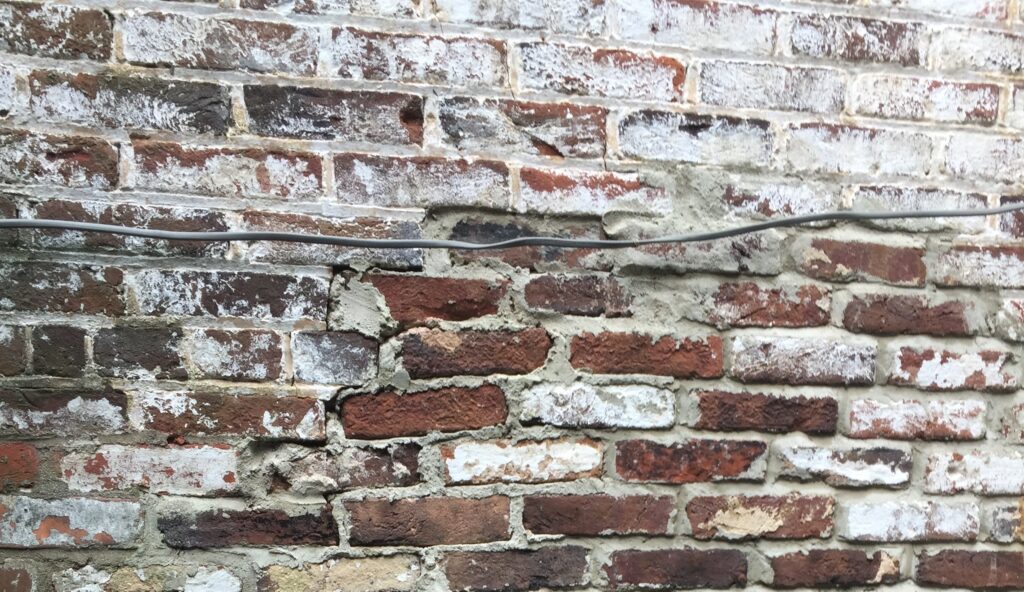
The white, chalky, fuzzy deposits you’ll see on old basement walls (and sometimes on the exterior) are efflorescence — mineral salts dissolved by water moving through the masonry and then deposited on the surface as the water evaporates.
Efflorescence is not a problem by itself. It’s a witness — it tells you water has moved through the wall. The question is whether it’s a small amount of historical moisture (usually fine) or active, ongoing water intrusion (a problem worth solving).
I look at:
- Whether the deposits feel powdery (older, often dormant) or crystalline and hard (more recent, often active)
- Whether there’s a visible wet line or active drip path
- Whether the surrounding mortar is still sound or has been weakened
- Whether the efflorescence is concentrated under a specific exterior feature like a downspout or a hose bib
If efflorescence is paired with active dampness, soft mortar, and step cracks, you have a water management problem to solve. If it’s a powdery historical deposit on a wall that’s been dry for decades, you fix the cosmetics with a wire brush and move on with your life.
5. The water management story — which is 80% of foundation problems
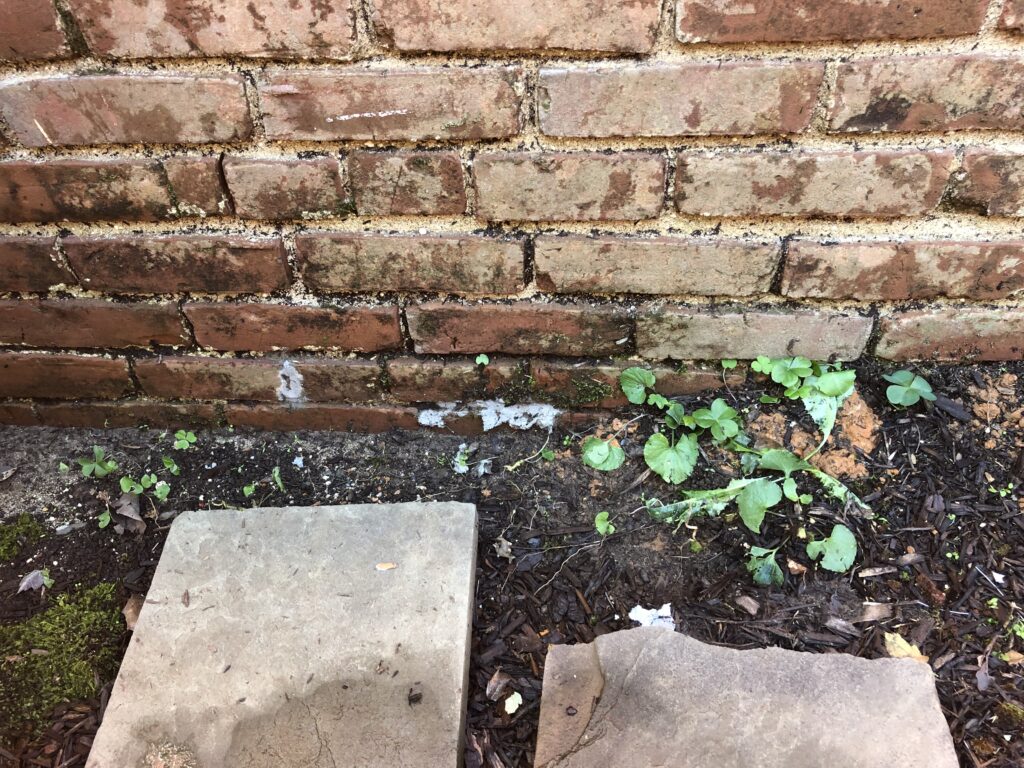
Here is the truth nobody tells homebuyers about historic foundations: nine times out of ten, what looks like a foundation problem is actually a water management problem. The wall isn’t failing. Water is being aimed at it.
When I’m under a 100-year-old Loudoun home, I’m reading the moisture story:
- Where are the gutters dumping — and are they functional at all?
- How is the lot graded around the foundation?
- Is there hardscape (a brick patio, a sidewalk, an old driveway) channeling water back toward the house?
- Do interior moisture stains line up with exterior downspout locations?
- Is there efflorescence concentrated below specific spots on the wall?
A foundation that’s been managing water poorly for 100 years can often be stabilized with $400 of gutter and grading work — without touching the foundation itself. A foundation that’s been managing water well for 100 years rarely needs anything done at all.
What does need immediate attention
Honest disclosure: most of what I see in old Loudoun foundations doesn’t need anything done. But three findings always warrant immediate follow-up:
- Active settlement — fresh cracks, ongoing movement, or doors and windows that are getting harder to operate over weeks or months.
- Significant water intrusion — a basement that’s actively wet, or visible moisture damage to floor framing above.
- Compromised structural masonry — stones that have lost their bearing, walls that bow noticeably, or any visible bulge greater than the thickness of the wall divided by 250.
For any of those, I refer to a structural engineer, not just a mason. The engineer designs the fix; the mason executes it. Both matter.
For everything else — historical settlement, lime mortar weathering, dormant efflorescence, cosmetic parging issues — the answer is almost always “monitor and maintain,” not “rebuild.”
Why this matters for a buyer
If you’re buying a 100-year-old Loudoun home, the foundation is the system most likely to be misread by a generic inspection. The result is buyers who walk away from beautiful, structurally sound houses because someone wrote “foundation deterioration noted” without understanding what they were looking at — or, worse, buyers who close on homes with active settlement that was missed because the inspector didn’t know how to tell stable cracks from moving ones.
A good inspection of a historic foundation should leave you with a clear picture: this much movement happened decades ago and has stopped, this much is happening now, this is normal for the era and material, and this is what needs a specialist’s eye. Not a list of “possible concerns” written in a tone that scares you out of a house that’s been standing fine since Theodore Roosevelt was president.
If you’re under contract on a pre-1930 home in Warrenton, Loudoun, Rappahannock, or anywhere across the region — that’s the inspection I want to do for you. Twenty years of masonry work behind the report.
Schedule a Historic Home Inspection →
Or call (540) 270-2501. I answer my own phone.
Matt is the owner and inspector at Dogwood Home Inspection in Warrenton, Virginia. He’s InterNACHI certified, Virginia licensed, and spent two decades in the trades — including extensive masonry work — before starting Dogwood. He inspects homes across Fauquier, Loudoun, Prince William, Culpeper, Rappahannock, Madison, and Orange counties.